Under New Management — New ownership, same family values. Faster response, better communication, and the quality your operation deserves.
Get a Quote Home
All Solutions Conveyor Components & Parts Machining Fabrication On-Site Services Plant Modernization Scheduled Replacement Machines & Materials
All Industries Agriculture Mining & Cement Construction & Roads Airports Marine Food & Beverage Wastewater
Our Work
About A&K Careers Contact Us
Contact Us 904-388-7772 sales@akmachinefab.com
Take-Up Assemblies & Belt Tensioning

Keep the Belt Tracking. Keep the Drive Gripping.

Screw take-up frames, gravity take-up assemblies, snub pulley brackets, and tension roller mounts — fabricated to your belt width and load profile. Drop-in replacements for legacy take-ups that have rusted past serviceable.

Why A&K for Take-Ups

The Component That Keeps Tension Right

Belt tension is what keeps a conveyor tracking straight and transmitting drive torque without slip. The take-up is the mechanism that maintains that tension as the belt stretches, contracts with temperature, or wears with cycles. When a take-up rusts out, the symptoms are loose belt, slipping drive, and erratic tracking — and the only fix is replacement.

A&K fabricates screw take-up frames, gravity take-up assemblies, snub pulley brackets, and tension roller mounts. Sized to your belt width and load. New systems for new installs; drop-in replacements that mount to your existing frame bolt pattern without modification.

Screw take-ups for manual periodic adjustment
Gravity take-ups for automatic constant-tension service
Snub pulley brackets to increase drive-pulley belt wrap
Bend pulley assemblies for routing the belt around obstacles
Drop-in retrofits matched to existing frame bolt patterns
Carbon steel default; galvanized or stainless for wet service
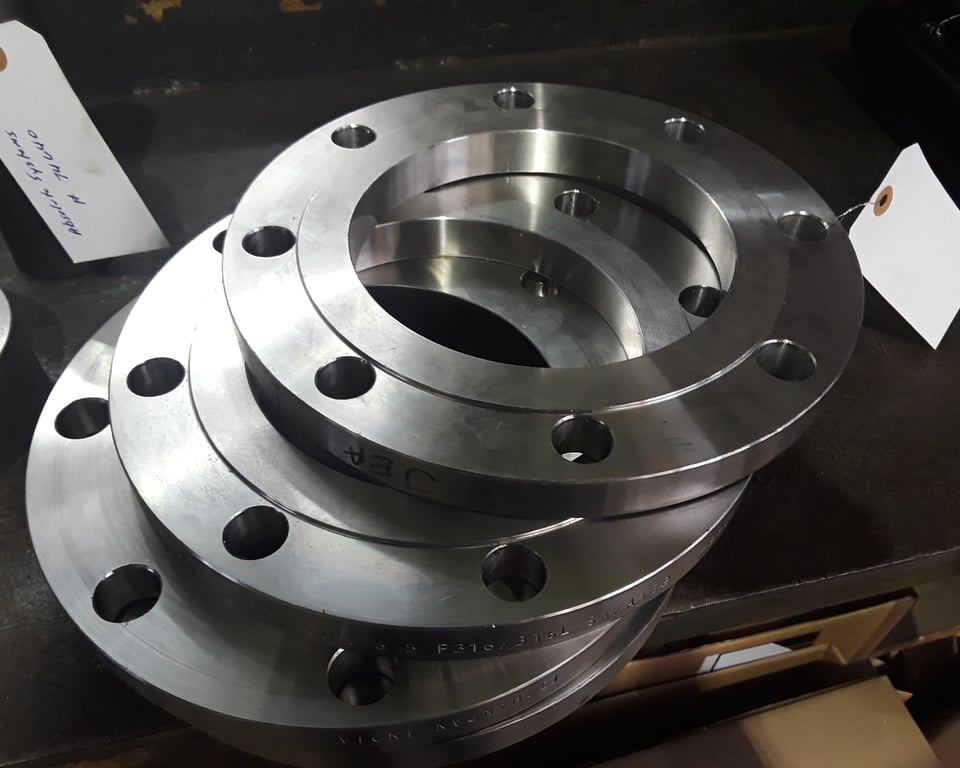
Heavy fabricated steel flange ring component — A&K Machine & Fabrication, Jacksonville FL
Take-Up Types

Pick the Tensioning Method

Screw Take-Up Frames

Manual screw-adjustable take-up frames with slotted bearing housings, threaded take-up rods, and lock nuts. Fabricated to your belt width, frame height, and bearing-bolt-pattern spec.

Vertical Gravity Take-Ups

Counterweighted vertical take-ups for long-center conveyors needing automatic constant tension. Fabricated frames, machined slide assemblies, counterweight boxes sized to the CEMA tension calc.

Horizontal Gravity Take-Ups

When overhead clearance won't allow a vertical drop, a horizontal carriage tensioned by a counterweight and deflector pulleys. Same constant-tension behavior, no headroom required.

Pneumatic / Hydraulic Cylinder

Active cylinder-actuated take-ups with pressure regulation — up to ~17 klbf line pull. Right when load varies or starting torque spikes above 1.3–1.5× steady-state.

Electric Winch (Constant Tension)

All-electric winch take-ups for overland and long-center conveyors — 20–150 klbf line pull, closed-loop pressure feedback, no hydraulic plumbing. The modern volume product for new high-tension installs.

Snub Pulleys & Tension Rollers

Snub pulley brackets that increase belt wrap on the drive pulley for better grip, plus tensioning rollers and bend pulleys for routing the belt around complex paths.

Take-Up Bearing Housings

Slotted-frame bearing housings designed specifically for take-up positions — paired with our take-up frames or supplied separately for retrofit.

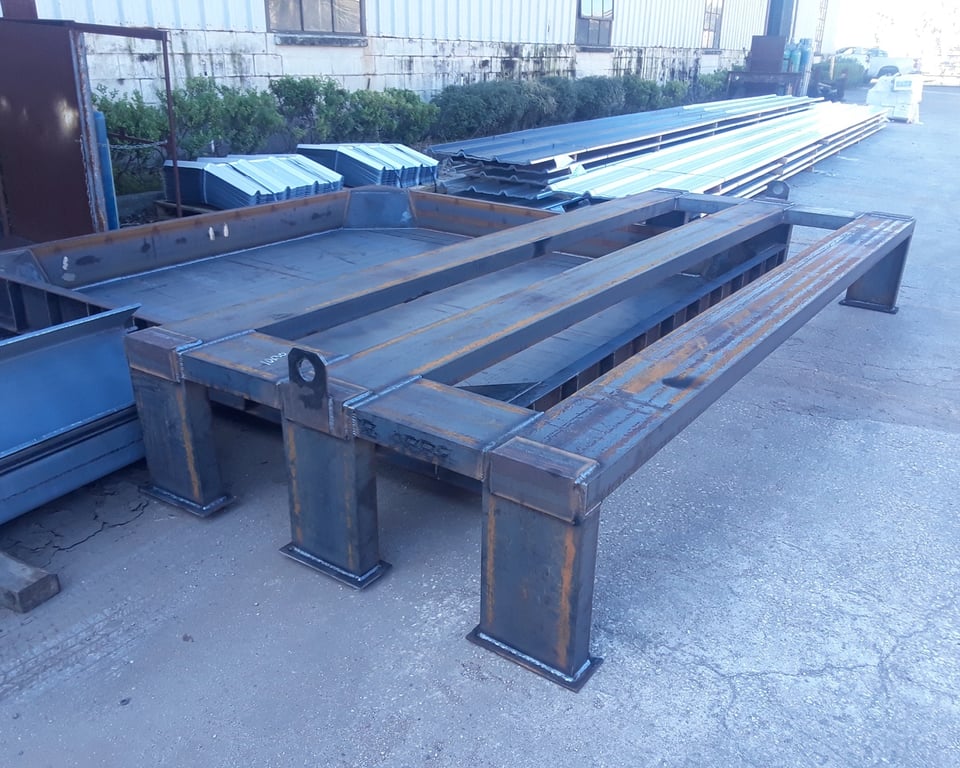
Heavy blue-painted fabricated steel frame in the A&K shop — A&K Machine & Fabrication, Jacksonville FL
Pick the Method

Screw vs Gravity vs Active

The right take-up depends on conveyor length, belt construction, drive configuration, and how much tension fluctuation the belt and idler-flex spec will tolerate.

Screw take-up
Short conveyors (under ~150 ft), fabric belt, low duty-cycle stretch, periodic manual adjustment acceptable.
Vertical gravity
Long-center conveyors (200 ft+), constant tension required, head clearance available for a counterweight tower.
Horizontal gravity
Long-center conveyors when overhead clearance is restricted — uses deflector pulleys and a horizontal carriage.
Cylinder (pneumatic/hydraulic)
Up to ~17 klbf line pull, tight-space, or starting-torque service where a counterweight box won't fit. Pressure-regulated.
Electric winch
20–150 klbf line pull for overland and high-tension installs — closed-loop pressure feedback, no hydraulic plumbing.

A&K helps you size and select — send us belt construction, conveyor centerline, drive HP, and pulley wrap. All five styles can be drop-in retrofitted onto an existing structure.

Behind the Sizing

The CEMA Tension Math, In Plain Terms

Every take-up gets sized off the CEMA tension calc. Send us belt construction, conveyor centerline, drive HP, and pulley wrap, and we run the numbers. Here's the short version of what's happening:

Te — Effective tension
The net force the drive transmits to the belt. Derived from horsepower, belt speed, conveyor profile (lift), and friction.
T1 — Tight-side tension
The belt tension entering the drive pulley. T1 = Te + T2.
T2 — Slack-side tension
The belt tension leaving the drive pulley. The take-up's job is to maintain T2 high enough that the belt doesn't slip on the drive face.
Cw — Wrap factor
Function of drive arrangement and lagging. Single-drive bare 180°: Cw ≈ 0.84. Single-drive lagged 180°: Cw ≈ 0.5. Dual-drive lagged 420°: Cw ≈ 0.08. Lower Cw = smaller counterweight.
T2-slip vs T2-sag
T2 must be the larger of T2-slip (Te × Cw) and T2-sag (idler-spacing × belt-weight ÷ allowable sag). Sag governs on lightly-loaded long-center conveyors; slip governs everywhere else.

For a gravity take-up, counterweight ≈ 2 × T2 (two belt strands hanging off the take-up pulley). For a screw or cylinder take-up, the force is the take-up rod load, also tied to T2. The take-up style itself is the design lever — pick a method with a lower Cw, and the counterweight box shrinks accordingly.

Standard reference: CEMA "Belt Conveyors for Bulk Materials" (the "Belt Book"), 7th edition
Belt-stretch travel: fabric (EP/NN) 1.5–2.5% of centerline; steel-cord ≈ 0.3%
Sag limit: typically 2% on bulk-handling conveyors, 1% on hot or fines-prone loads
Service factor: starting torque can spike 1.3–1.5× steady-state on direct-driven loads
We document the tension calc on every quoted assembly — engineering review on request
Our Process

From Loose Belt to Tracking Conveyor

01

Site & Spec

Conveyor length, belt construction, drive specs, frame bolt pattern. Send measurements or our crew comes out to field-measure.

02

Calculate & Quote

We size the take-up: tension calculation, travel range, counterweight if gravity. Fixed quote with real lead time.

03

Fabricate

Frame welded, slide tracks machined, bearing housings bored, paint applied. All hardware staged and labeled.

04

Install

Drop-shipped or our crew installs on-site. Belt re-tracked, tension verified at startup.

Industries

Who We Supply Take-Ups To

Common Questions

Take-Up FAQ

How do I tell if my take-up needs replacement vs adjustment?

Adjust first — most "take-up problems" are just under-tension belts. If the take-up is at end-of-travel or the threads/slide assemblies are seized, it's replacement time. Rust through the frame plates, sloppy slide fits, or bearing housings that won't track straight are all replacement signals.

Can you make a take-up to bolt onto my existing frame?

Yes — most of our take-up work is retrofit. Send us the frame bolt pattern and the existing take-up travel range, and we'll fabricate to drop in without modifying the structure.

How much take-up travel do I need?

Depends on belt construction. Fabric (EP/NN) carcasses elongate 1.5–2.5% under load — plan ~1.5% of conveyor centerline plus initial slack. Steel-cord belts elongate ~0.3% — much shorter stroke. A 400-ft fabric-belt conveyor wants ~6 ft of travel; the same length in steel-cord wants closer to 1.5 ft. Send us the belt spec and centerline and we'll size it.

What's the counterweight calculation for a gravity take-up?

Standard CEMA rule: counterweight = 2 × T2 (the gravity weight pulls two belt strands). T2 is the larger of T2-slip (Te × Cw) or T2-sag. On a single-drive conveyor with manual take-up and 180° wrap, Cw ≈ 0.5 — so counterweight ends up roughly 2 × Te. Dual-drive lagged with an auto take-up and 420° wrap drops Cw to ~0.08 and counterweight to ~0.16 × Te. The take-up style is the design lever — that's why we run the calc before fabricating the box. Send us belt construction, centerline, drive HP, and pulley wrap.

Can you re-galvanize an existing take-up frame instead of replacing it?

If the frame plates aren't pitted through and the slide assemblies still move freely, yes — we can sandblast, re-paint or re-galvanize, replace the bearing housings, and put it back into service. Send us photos and we'll tell you whether it's worth it vs replacement.

Other Conveyor Components

Adjacent Drive Components

Get a Quote

Start Your Project

Send us your details — drawings, dimensions, or just a description. We'll get back to you within 48 hours on most quotes. For faster response or lead time questions on jobs, just call.

PDFs, images, Office docs, CAD files, or ZIPs — max 20MB.
Need to send more? You can upload additional files after submitting.

or call 904-388-7772

Fast Response

We respond to most quote requests within 48 hours. For faster responses or lead time questions on specific jobs, call us directly at 904-388-7772.

We Ship Anywhere

Based in Jacksonville, FL — we ship finished parts and components throughout Florida, the Southeast, and beyond.

Prefer to Call?

Reach us at 904-388-7772, Mon–Fri 7:00 AM – 3:30 PM (closed Sat–Sun).