Under New Management — New ownership, same family values. Faster response, better communication, and the quality your operation deserves.
Get a Quote Home
All Solutions Conveyor Components & Parts Machining Fabrication On-Site Services Plant Modernization Scheduled Replacement Machines & Materials
All Industries Agriculture Mining & Cement Construction & Roads Airports Marine Food & Beverage Wastewater
Our Work
About A&K Careers Contact Us
Contact Us 904-388-7772 sales@akmachinefab.com
Auger Flighting, Shafts & Trough Components

Move the Bulk That Belts Can't.

Custom helical auger flighting — carbon, AR400/AR500, or stainless — welded to your shaft spec. Replacement shafts, U-trough housings, replaceable liners, and hanger bearings to match. New screw conveyors from spec or refresh the worn parts of an existing one.

Why A&K for Augers

Where Belt Conveyors Stop, Screws Start

Screw conveyors handle the bulk material that belt conveyors can't — flour, powder, sticky aggregate, hot ash, slurry. They're simpler, dust-tight, and they move material vertically as well as horizontally. But the flighting is the wear part, and once it's worn down, your throughput drops and the trough takes the hit.

A&K cold-rolls helical flighting from carbon, AR-plate, or stainless. Welded to a custom shaft, paired with a U-trough housing and replaceable liners, with intermediate hangers and end-shaft bearing supports. Replace just the flighting and reuse the trough, or build a complete new screw conveyor from spec.

CEMA 350-standard helicoid and sectional flighting; CEMA 300 component dimensions
Helicoid (cold-rolled from one piece) or sectional (welded segments) flighting
Cut flight (CF), cut & folded flight (CFF), ribbon, paddle, variable-pitch profiles
Materials: carbon, AR400/AR500, 304/316 stainless, abrasion-resistant Hardox
Hanger bearings per CEMA letter codes (UHMW, NR, W, BR, B, H, S, ceramic)
U-trough variants, tubular housing, flared trough, jacketed (steam/cooling), drop-bottom
Hardfacing options: chrome carbide overlay (CCO), brazed carbide tile, HVOF, Stellite, Colmonoy
Shaftless screw conveyor flighting on request — for stringy/fibrous material
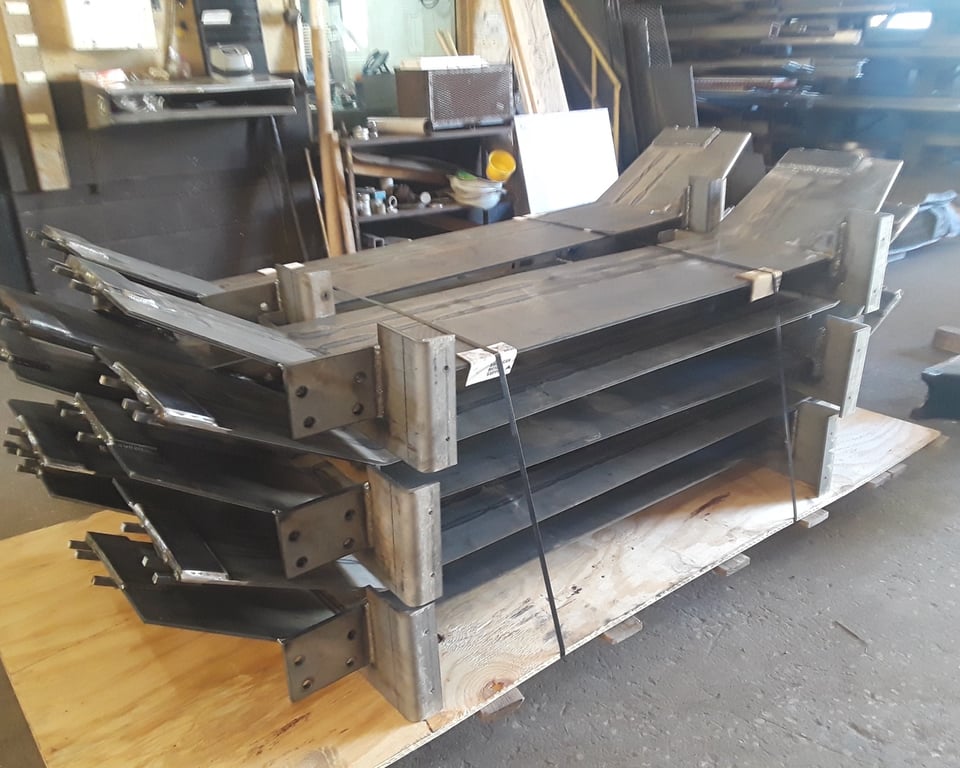
Long stainless steel industrial component (auger-like) in the A&K shop — A&K Machine & Fabrication, Jacksonville FL
Screw Conveyor Components

The Full Auger Assembly

Helicoid Flighting

Cold-rolled from a single piece of plate into a continuous helix, then welded to the shaft. Smooth uninterrupted leading edge — best for clean material flow with minimal build-up. Up to ~24" OD per pitch in standard rolling capacity; in carbon, AR400/AR500, or 304/316 stainless.

Sectional Flighting

Individual welded segments — each section laser- or plasma-cut from plate and welded together along the shaft. Right for diameters and material thicknesses that exceed helicoid rolling capacity, plus easier repair of worn sections without replacing the full auger.

Special Flight Profiles

Cut Flight (CF) for mixing; Cut & Folded Flight (CFF) for aggressive blending and aeration; Ribbon flight for sticky/wet material that would pack on full flights; Paddle flight for mixing and even feeding; Variable / tapered pitch for compaction or controlled discharge.

Auger Shafts & Couplings

Solid auger shafts with stub-shaft ends, keyways, and bolt-pattern couplings machined to fit your drive and bearing housings. CEMA standard pipe-size shafts (2-7/16", 3", 3-7/16", 4") plus custom diameters. Replacement shafts for worn augers — keep the flighting, refresh the shaft.

Trough Housings

U-trough screw conveyor housings in carbon or stainless. Variants: flared trough (more capacity), tubular (dust-tight high-pressure), jacketed (steam/cooling), drop-bottom (cleaning access), and rectangular (replaceable flat-pack liners). Top covers in flat, peaked, or domed profiles.

Hanger Bearings

Intermediate hanger bearings — Style 216, 226, 326, 660, and 670 supports, with CEMA letter-code bushings: U (UHMW), NR (natural rubber), W (wood — yes, still spec'd), BR (bronze), B (Babbitt), H (hardened iron), S (stainless), and ceramic for severe abrasive service.

Shaftless Screw Conveyors

Heavy-gauge spiral flight running directly inside a UHMW or polymer trough liner — no center shaft, no intermediate hangers. The right call for stringy, fibrous, or wet sticky materials (biosolids, sludge, food waste, recyclable fiber) where a center shaft would clog.

Hardfacing & Wear-Resistant

For abrasive bulk service (sand, frac sand, ash, slag, taconite). Chrome carbide overlay (CCO / Chromeweld 600) as standard weld overlay; brazed tungsten-carbide tile or HVOF-applied carbide coating for the worst service; Stellite or Colmonoy hardfacing rods where higher temperatures or specific corrosive chemistry rule out CCO.

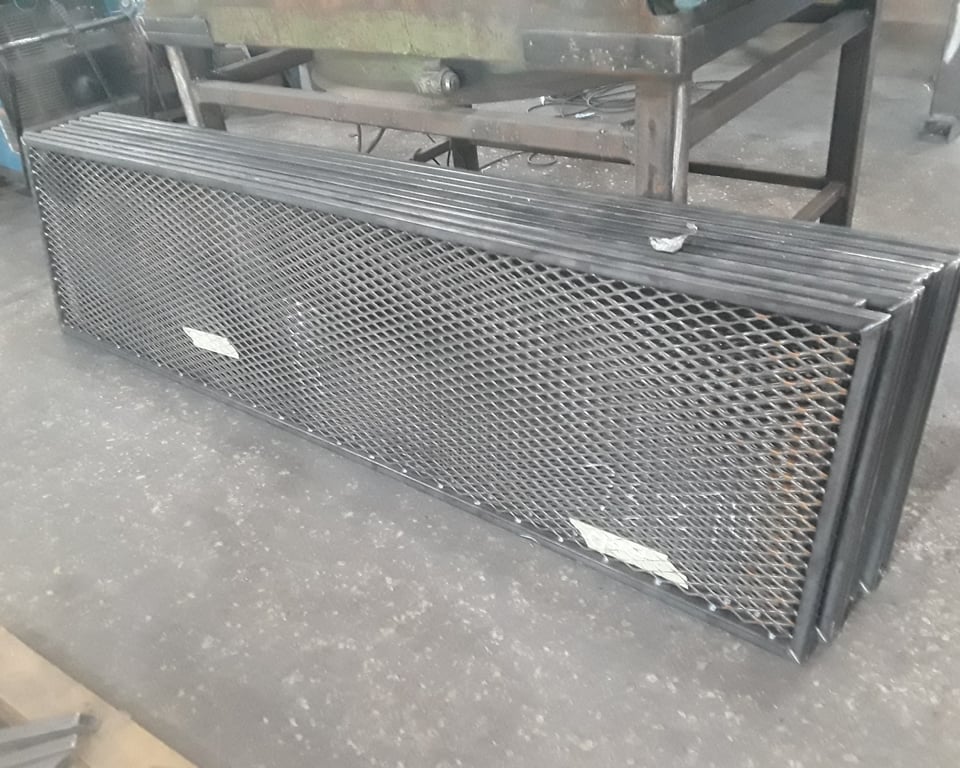
Stainless steel mesh basket / screen assembly — A&K Machine & Fabrication, Jacksonville FL
Materials & Pitch

Match the Steel — and the Pitch — to the Material

Two specs drive auger performance: the steel choice (drives wear life) and the pitch (drives material handling behavior — capacity, fill rate, controlled feed, mixing).

Standard pitch (= diameter)
Default for horizontal and inclined conveyors up to ~20°. Highest throughput per RPM.
Short pitch (2/3 diameter)
Steep inclines (~20–45°) and applications needing tighter material control. Reduces fall-back at higher angles.
Half pitch
Vertical screw conveyors and very steep inclines. Smaller pitch keeps material captured between flights.
Long pitch (1.5× diameter)
Agitating, mixing, fast-feeding, and stirring applications. Lower fill rate, higher slip — that's the point.
Variable / tapered pitch
Pitch changes along the screw length — for controlled feed from a hopper, even discharge, or compaction.
Double-flight (twin helix)
Smoother feed and less pulsation in metering applications. Two helices running in parallel on the same shaft.
Carbon (A36/1018)
Grain, dry food product, general bulk handling. The default starting point.
AR400 / AR500
AR400 for sand and moderate aggregate; AR500 for slag, ash, mining tailings, primary-crusher discharge.
Stainless 304 / 316
304 for food contact and mild corrosion; 316 for marine, sanitary, and chemical service. Sanitized welds for FDA/3-A applications.
Hardfaced (CCO / HVOF / brazed tile)
Extreme abrasion. Chrome carbide weld overlay is standard; HVOF coating or brazed tile for the worst service. 3–10× service life vs the base steel.
Our Process

From Worn Auger to Refreshed Screw

01

Spec

Send the worn auger, the screw conveyor model, or the bulk-material spec sheet. We confirm flight OD, pitch, shaft size, and trough geometry.

02

Material Pick & Quote

We recommend material per failure mode — abrasion, corrosion, food-contact. Fixed quote with real lead time.

03

Roll & Weld

Helical flighting cold-rolled to pitch, welded to shaft, end-shaft features machined. Optional hard-face overlay applied to flight edges.

04

Ship or Install

Crated and shipped, or installed on-site during your scheduled outage by our service crew.

Industries

Who We Supply Augers To

Common Questions

Auger FAQ

Can you replace just the flighting and keep my existing shaft?

Yes — this is the most common ask. If the shaft is still straight and the bearing journals are intact, we cut off the worn flighting and weld new on. About 40-60% of the cost of replacing the whole auger.

Helicoid vs sectional flighting — what's the difference?

Helicoid flighting is cold-rolled from a single piece of plate into a continuous helix and welded to the shaft — smooth, uninterrupted leading edge, best for clean material flow. The limit is rolling capacity: above about 24" OD or above heavier plate thicknesses, helicoid isn't practical. Sectional flighting is built from individual plate segments — each laser- or plasma-cut, formed, then welded to the shaft and to each adjacent segment. Both result in welded (not bolted) assemblies. Pick helicoid for clean service and smaller diameters; pick sectional for large diameters, thick plate, or hardfaced flight where individual segments can be replaced as they wear.

Do you make food-grade augers?

Yes — stainless 304 and 316 flighting and shafts, with welded joints cleaned and passivated to food-contact standards. Trough liners in FDA-grade UHMW. Tell us the product and the cleaning protocol (CIP, COP, dry sanitation) and we'll spec accordingly.

Can hardfacing really extend auger life that much?

For highly abrasive material, yes — 3–10× life increase is typical. The leading edge of each flight is where 90% of the wear happens, so we concentrate the hardfacing there. Three common approaches: Chrome carbide overlay (CCO / Chromeweld 600) is the workhorse — a weld overlay rich in chromium carbides, deposited 1/8"–1/4" thick. Brazed tungsten-carbide tile for the worst single-point wear — small carbide blocks brazed onto the flight edge. HVOF (high-velocity oxy-fuel) tungsten-carbide coating for thinner, smoother coverage. Note: "tungsten-carbide overlay weld" isn't really a thing — tungsten carbide isn't weld-deposited the way chrome carbide is; it's brazed as tile or sprayed as HVOF coating. Trade-off across all three: cost vs life, and harder to re-flute when it does eventually wear.

What's the right pitch for steep inclines and vertical screw conveyors?

Standard pitch (pitch = diameter) handles horizontal and inclines up to ~20°. From 20–45°, switch to short pitch (2/3 of diameter) to keep material from falling back between flights. Vertical screws (90°) use half pitch and run at much higher RPM than horizontal — material is held against the trough by centrifugal force, not flight angle. CEMA 350 has full capacity tables. Send us the elevation profile and material density and we'll match the pitch.

Which hanger bearing letter code should I spec?

The CEMA letter codes (U, NR, W, BR, B, H, S, ceramic) are picked by material being conveyed and the environment. U (UHMW) is the workhorse for dry granular and most general service. NR (natural rubber) for moderate abrasion in moist conditions. BR (bronze) for high-temperature service where polymers would creep. H (hardened iron) for general industrial abrasion. B (Babbitt) for low-RPM heavy-duty. S (stainless) for food and chemical. Ceramic for the worst abrasive service (frac sand, ash, taconite). Style numbers (216, 226, 326, 660, 670) refer to the hanger body itself; we match yours from the worn sample.

What's the lead time on a replacement auger?

Standard carbon-steel flighting: 2-3 weeks (material + rolling + welding). AR plate or stainless adds a few days for material sourcing. Hard-faced augers: 3-4 weeks. Call 904-388-7772 with your spec — we'll give you a real answer before you commit.

Other Conveyor Components

Related Bulk-Handling Parts

Get a Quote

Start Your Project

Send us your details — drawings, dimensions, or just a description. We'll get back to you within 48 hours on most quotes. For faster response or lead time questions on jobs, just call.

PDFs, images, Office docs, CAD files, or ZIPs — max 20MB.
Need to send more? You can upload additional files after submitting.

or call 904-388-7772

Fast Response

We respond to most quote requests within 48 hours. For faster responses or lead time questions on specific jobs, call us directly at 904-388-7772.

We Ship Anywhere

Based in Jacksonville, FL — we ship finished parts and components throughout Florida, the Southeast, and beyond.

Prefer to Call?

Reach us at 904-388-7772, Mon–Fri 7:00 AM – 3:30 PM (closed Sat–Sun).