UHMW chute liners, AR400/AR500 abrasion plate, ceramic-faced panels, and rubber-topped impact bars — cut, drilled, and countersunk to your chute drawing. Bolt-on retrofits that drop straight onto existing frames.
Every load point, transfer chute, and impact zone needs sacrificial wear material between the product and the structural steel. The whole point is that the liner wears so the chute doesn't. Skip it, and you're cutting and welding new chute walls every 6 months.
A&K cuts and drills UHMW, AR400, AR500, and ceramic-faced wear panels to your chute geometry. Counterbored bolt holes for flush flat-head bolts. Pre-finished edges. Labeled by location so install crews don't have to think.

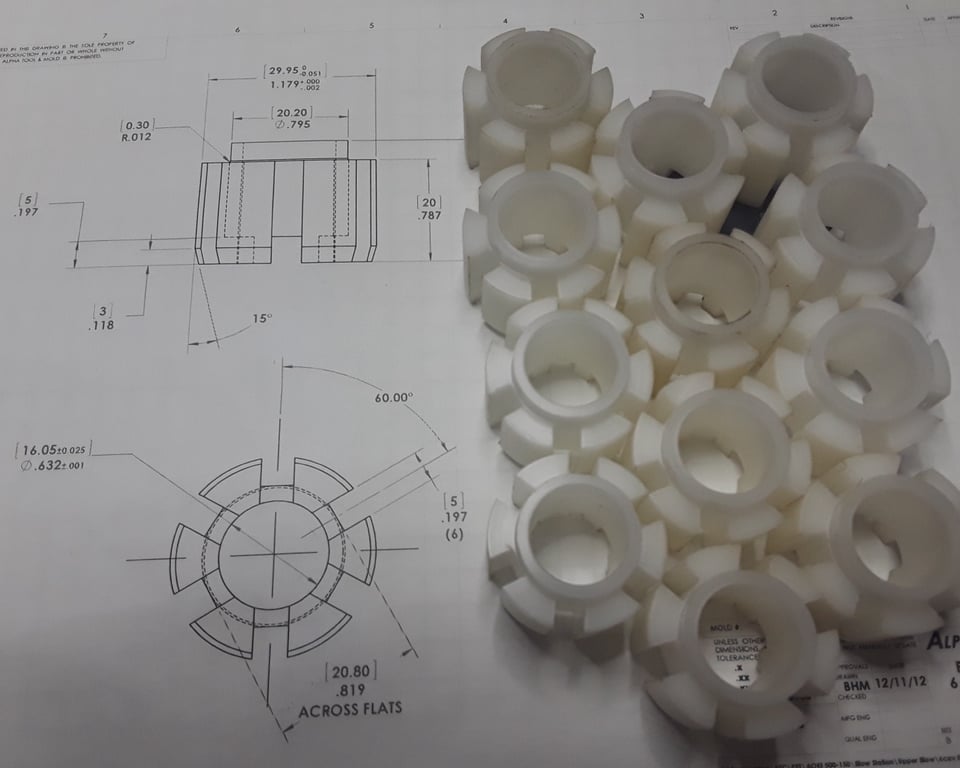
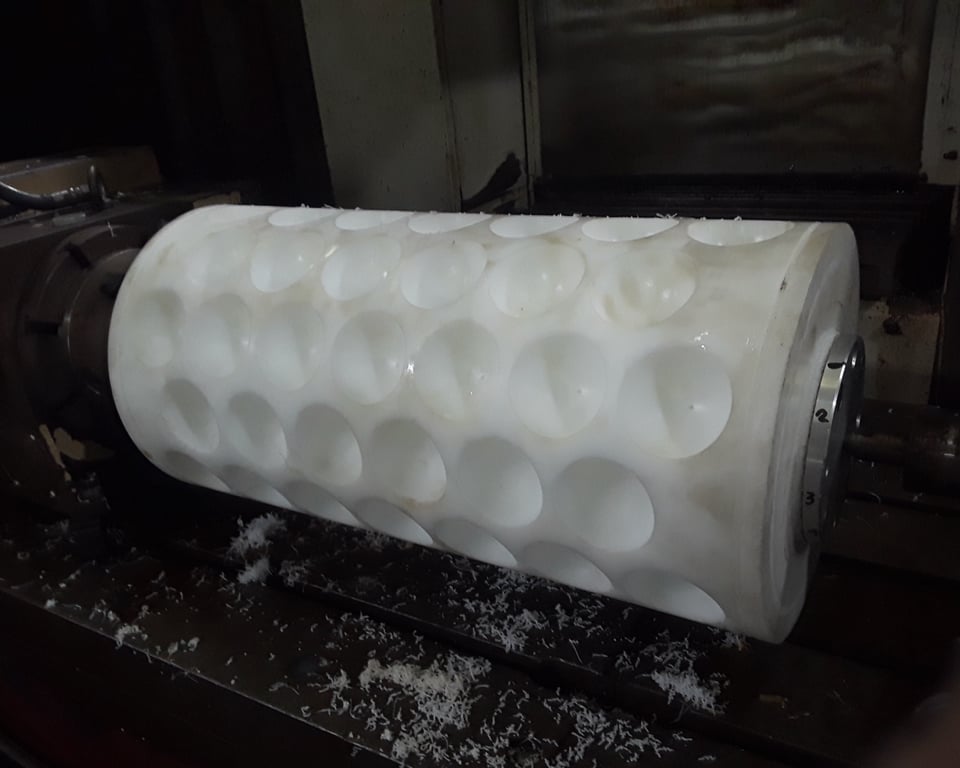
Ultra-high-molecular-weight polyethylene cut, drilled, and counterbored to chute geometry. Lowest coefficient of friction of any liner material — sticky material slides instead of building up. Standard grade, TIVAR 88 anti-static (for combustible dust), TIVAR 1000 (higher impact strength), and FDA-compliant white grades for food.
Through-hardened steel plate for high-impact and abrasive load points. AR400 (360–444 HBW) for general aggregate, AR500 (477–534 HBW) for severe-duty mining and quarry chutes. Hardox 450/500/600 supplied on request. Plasma- or water-jet cut, counterbored for flush flat-head bolts.
Rubber-topped impact bars and full impact beds under load points to absorb drop energy and protect the belt. Standard 4" and 6" bar widths, custom-length beds. Three duty grades: Light Duty (under 50 ft-lb impact), Medium Duty (50–250 ft-lb), Heavy Duty (250+ ft-lb).
Ceramic tiles (92%, 95%, or 99% Al₂O₃ purity) bonded onto AR-plate or rubber backing. Mohs ~9 surface hardness — multiple times the life of AR500 in glass, slag, taconite, and abrasive ash. Drop-in replacement for plate-only liners.
Tungsten-carbide brazed-tile inserts for the worst single-point impact zones; chrome carbide overlay (CCO) plate — a carbide-rich weld overlay on a steel backing — for large-area severe-abrasion service in coal, ore, and slurry chutes. Routinely outlasts AR500 by 5–10×.
Wear-resistant panels with embedded permanent magnets — install in minutes without bolts, drilling, or welding. Standard for ferrous-material chutes where downtime is the dominant cost; the magnet field holds them against the steel chute wall.
Steel skirtboard frames with replaceable rubber or urethane skirt seal at the belt edge. Seals the load zone against dust and fines without dragging on the belt. SBR for standard service, urethane for abrasive, FDA white for food.
Sacrificial bar-stock and plate wear strips for high-wear edges — chute lips, transition corners, throat guides. Bolt-on so replacement doesn't require welding. AR400, AR500, or carbide-faced depending on the wear pattern.

Picking the right liner is mostly about understanding the dominant wear mode — sliding-abrasion, impact, or a combination — and the temperature ceiling. Pick wrong, and the liner wears out faster than the steel chute did.
Send your chute drawing — or our crew comes out and field-measures. Liner panels mapped to chute zones; bolt-hole pattern captured.
We recommend liner material per chute zone — different sections may need different materials. Fixed quote with real lead time.
Water-jet, plasma, or saw-cut to drawing. Holes drilled and counterbored for flush flat-head bolts. Edges deburred, labeled by chute location.
Palletized by chute zone; install crews don't have to think. For customers in our service area, we install on-site during your scheduled outage.
If material is sticking or building up on the chute, you want UHMW (the low-friction surface keeps product moving). If material is abrasive and high-energy, you want AR400 or AR500 (steel can take impact + abrasion that would tear UHMW apart). For "sticky AND abrasive" mixed-mode wear, mix them — UHMW on the sliding faces, AR on the impact zones.
Standard UHMW thickness is ½" to 1" depending on duty; AR plate is typically ¼" to ¾". The right thickness is "thick enough to last between your scheduled maintenance windows." If you're replacing more than once a year, go thicker; if you're over-replacing, go thinner.
By default, the liners ship pre-drilled and counterbored — you supply your standard hex-head or flat-head bolts. If you want hardware included (often the case for food-grade or stainless installs), we'll match the material spec.
Yes — most of our liner work is retrofit, not new-build. Send us the chute drawing, OEM liner part number, or even a worn original. We match the hole pattern and panel dimensions exactly.
In the right application, yes. Alumina ceramic surface hardness is ~9 on the Mohs scale; hardened AR500 is ~7–8. Against abrasives that are themselves Mohs 7+ (silica sand, glass cullet, taconite), that gap matters — ceramic-faced panels typically deliver 5–10× the life of AR500 in those services. Worth it on transfer chutes that see slag, glass, abrasive ore, or fly ash. Less compelling on softer materials like coal or limestone, where AR400/500 already lasts years.
UHMW has a continuous service temperature ceiling around 180°F (82°C); short excursions to 200°F are OK but it starts to soften and creep above that. For hot material (hot clinker, asphalt, hot foundry sand), UHMW is the wrong call — switch to AR plate, ceramic, or high-temp urethane. If the chute is outdoor and sees ambient heat plus material, factor in both.
CCO is a thick layer of chromium-carbide-rich weld overlay (typically 1/8" to 1/2") deposited onto an AR-plate base. The overlay is ~60–65 HRC with embedded chromium carbides. It's the right call for large-area severe abrasion — coal chutes at power plants, ore-handling chutes, slurry pipe spools. Outlasts AR500 by 5–10× in those services, drops in on the same bolt pattern, and we can cut it to your drawing.
The first line of defense at the head pulley — keeps carry-back out of the return-run zone where liners live.
Impact idlers paired with impact bars/beds give the belt cushion-on-cushion protection under load points.
Back to the full overview — pulleys, bearings, sprockets, take-ups, auger flighting, and more.
Send us your details — drawings, dimensions, or just a description. We'll get back to you within 48 hours on most quotes. For faster response or lead time questions on jobs, just call.
We respond to most quote requests within 48 hours. For faster responses or lead time questions on specific jobs, call us directly at 904-388-7772.
Based in Jacksonville, FL — we ship finished parts and components throughout Florida, the Southeast, and beyond.
Reach us at 904-388-7772, Mon–Fri 7:00 AM – 3:30 PM (closed Sat–Sun).