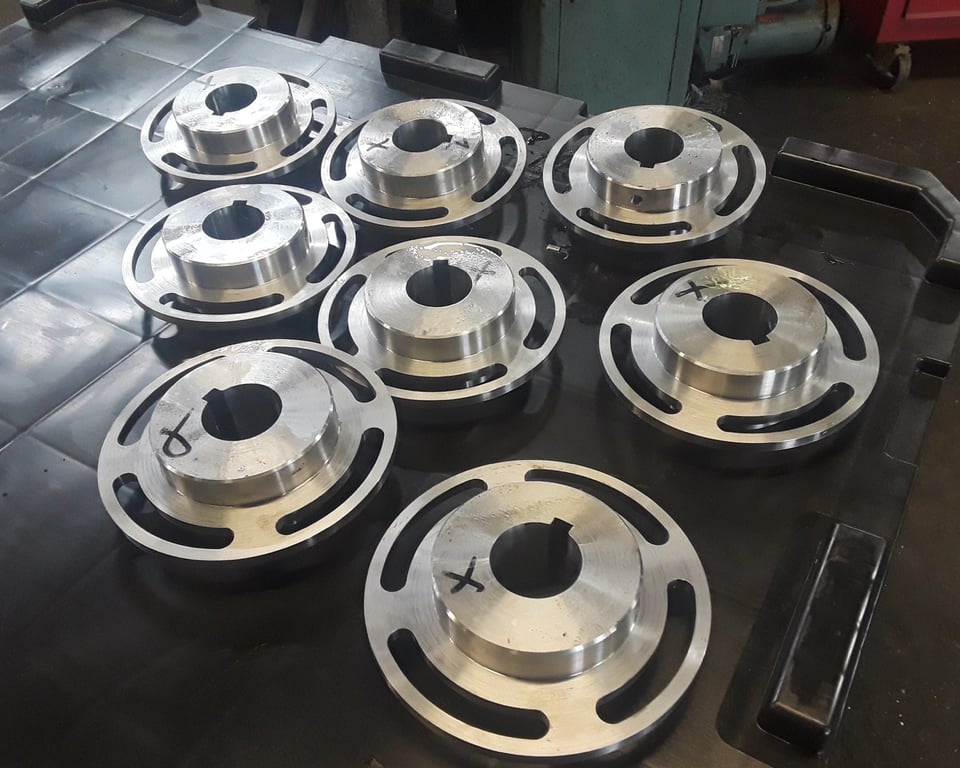
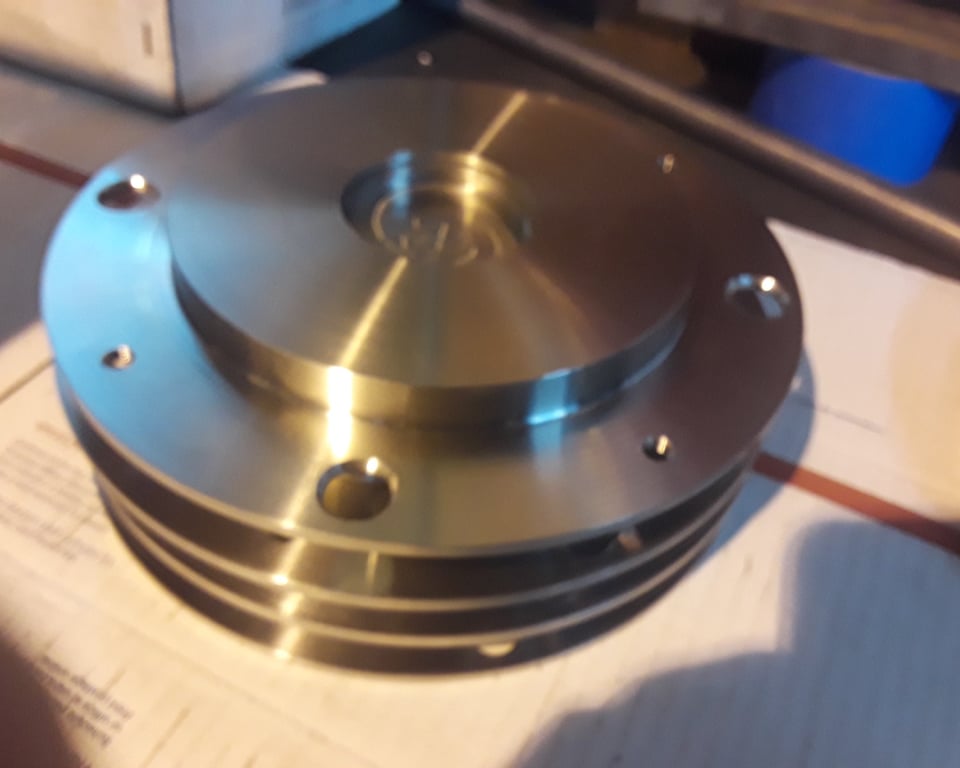
Head, tail, snub, bend, and takeup pulleys — fabricated and machined to your belt width, shaft size, and lagging spec. Plus the accessory components that make the pulley system work: locking elements, end disks, foot pads, and custom shafting.
Conveyor pulleys are the critical drive and directional components on every belt system. A&K fabricates and machines the full range — from standard head and tail pulleys to specialty snub and takeup configurations — plus the accessory parts that make them work: lagging, locking elements, end disks, and shafting.
We work from your existing pulley, your belt specs, or a clean-sheet design. Standard ANSI sizes for retrofit drop-ins, custom diameters and face widths for new builds, any lagging combination for any belt material.

Lagged head pulleys for the drive position — diamond- or herringbone-grooved rubber, ceramic-tile, or hot-vulcanized SBR matched to your belt and load. Crowned faces (1/8" per ft) for self-centering belt action.
Non-driven tail pulleys at the loading end. Standard drum or self-cleaning wing pulley (spiral-wrap above 450 ft/min per CEMA, wing-tail below). Sealed cartridge or greaseable taper-roller bearings.
Snub pulleys increase belt wrap on the drive pulley (commonly to 220°–240°) for better grip; bend pulleys route the belt around complex paths and take-up loops. Smaller diameters, often un-lagged.
Pulleys that ride inside the take-up frame — typically un-lagged or rubber-lagged. Sized to a 0.5–0.7× drive-pulley diameter and shaft-mounted in take-up bearing housings on slotted frames.
Solid pulley shafts and stub shafts machined from carbon, 4140 alloy, or 304/316 stainless. Keyways per ANSI B17.1, bearing-journal diameters, and shoulder dimensions cut to drawing.
Welded plate end discs (Duty & Mine Duty), turbine end discs (low-stress for large drums), and T-section forged-style discs (Super Duty). QD, Taper-Lock, XT, and Split Taper bushings; shrink discs for high-torque drives.

Lagging on a drive pulley is the friction interface between motor torque and belt tension. Wrong choice slips, glazes, or wears the belt prematurely — right choice transmits power for years. We spec to durometer, bond method, and compound.
The right CEMA Duty Class isn't a marketing tier — it's the engineering spec that ties drum diameter, shell thickness, end disc construction, and shaft size to the belt tension you're seeing. Under-spec'd, the drum fatigues at the end disc weld. Over-spec'd, you're paying twice for steel that isn't earning its keep.
What we need to size your pulley to the right class:
We don't push you up a class just to inflate the quote. If the calc says Mine Duty, that's what we build. We document the tension and bending-stress calc on every quote.
Send us the worn pulley, the belt width & speed, and the load profile. We'll figure out drum diameter, face width, lagging, and shaft sizing.
Fixed quote with material spec, lagging type, locking element, and real lead time — not a stock 8-week placeholder.
Drum rolled and welded, end disks machined, shaft turned, lagging applied. Concentricity and runout inspected before paint.
Crated and shipped, or our crew comes to your site and swaps it in during your scheduled outage — alignment and tracking included.
Crowned faces self-center the belt and are the default for most belt conveyors. Flat is used for specialty cases — wide belts where crowning would cause edge stress, or chain/modular belts that ride on guides instead of friction tracking. If you don't know, crowned is almost certainly right.
Ceramic-tile lagging is the default for wet conditions — the embedded ceramic tiles maintain friction even when water and slurry get on the drum face. Diamond- or herringbone-grooved rubber is the second choice (the grooves shed water). Bare steel is the wrong answer; it glazes and slips.
Yes — pulley re-lagging is a regular service. We strip the worn rubber/ceramic, prep the drum surface, and apply new lagging (vulcanized in shop or weld-on tile in the field). Typically about 30-40% of the cost of a new pulley with the same service life ahead of it.
All four are split-cone bushings that wedge a hub onto a shaft when bolts are tightened. Taper-Lock (originally Dodge) is the most common, single-piece tapered sleeve, h7 shaft fit. QD (Dodge "Quick Disconnect") has a flange and uses cap screws, slightly easier removal under load. XT bushings (Dodge) are higher-capacity for heavier-tension drives — through-bolt design. Split Taper (Browning) is interchangeable with Taper-Lock dimensionally but uses different keyway/bolt patterns. Shrink discs are an external clamp for the highest-torque service where bushing slip is the failure mode. We size all five depending on transmitted torque and disassembly access.
Plain 60 Shore A SBR rubber typically runs 1–3 years on a hard-working drive pulley in abrasive service. Ceramic-embedded rubber typically runs 5–10 years in the same conditions — the wear face is alumina ceramic (Mohs ~9) instead of vulcanized rubber. The premium is usually 2–3× the cost; pays back fast when downtime is expensive. We spec ceramic on every drive pulley over 50 HP unless the customer asks otherwise.
CEMA recommends spiral-wrap pulleys above 450 ft/min belt speed — at speed, wing pulleys vibrate the belt and accelerate edge wear, while spiral-wrap maintains continuous belt contact. Below 450 ft/min, wing-tail pulleys are fine and offer better self-cleaning of carry-back. Send belt speed, and we'll pick.
Standard sizes with bare-steel or rubber lagging: usually 5-10 business days. Ceramic-lagged or large custom drums: 2-3 weeks (mostly material + outside lagging vendor lead). Call 904-388-7772 with your specs and we'll give you a real answer before you commit.
The torque feed to every drive pulley — input/output shafts in carbon, alloy, or stainless with any keyway or spline.
Screw and gravity take-ups — the tensioning system that keeps belt grip on the drive pulley right.
Back to the full overview — idlers, bearings, scrapers, sprockets, auger flighting, and more.
Send us your details — drawings, dimensions, or just a description. We'll get back to you within 48 hours on most quotes. For faster response or lead time questions on jobs, just call.
We respond to most quote requests within 48 hours. For faster responses or lead time questions on specific jobs, call us directly at 904-388-7772.
Based in Jacksonville, FL — we ship finished parts and components throughout Florida, the Southeast, and beyond.
Reach us at 904-388-7772, Mon–Fri 7:00 AM – 3:30 PM (closed Sat–Sun).