Under New Management — New ownership, same family values. Faster response, better communication, and the quality your operation deserves.
Get a Quote Home
All Solutions Conveyor Components & Parts Machining Fabrication On-Site Services Plant Modernization Scheduled Replacement Machines & Materials
All Industries Agriculture Mining & Cement Construction & Roads Airports Marine Food & Beverage Wastewater
Our Work
About A&K Careers Contact Us
Contact Us 904-388-7772 sales@akmachinefab.com
Sprockets, Couplings & Drive Sheaves

Move the Torque to the Belt.

Conveyor chain and drag sprockets, drive sheaves, V-belt pulleys, gear and jaw couplings — carbon, alloy, cast iron, and UHMW. Standard ANSI pitches plus custom tooth profiles cut to drawing.

Why A&K for Sprockets

From Motor Shaft to Head Pulley

Sprockets, sheaves, and couplings are the power-transmission link between the motor and the conveyor belt. When a sprocket tooth wears out, the chain skips. When a coupling bore is off-spec, you get fretting and premature shaft wear. When a sheave is wrong, V-belts slip and squeal.

A&K machines all of them — chain sprockets in standard ANSI and metric pitches plus custom tooth profiles, drive sheaves for V-belt and synchronous belt drives, and gear/jaw couplings with custom bores and keyways to fit any drive train.

ANSI B29.1 Type II tooth form, pitches #25 through #240 (¼" to 3")
Custom tooth profiles for drag, scraper, drop-forged, and modular-belt chains
Classical V-belt sheaves (A/B/C/D/E) and narrow-wedge (3V/5V/8V)
Synchronous-belt: HTD, GT3 (replaces GT2/GT), L/H/XH profiles
All Type A (plain), Type B (single-flange), Type C (double-flange) hub configurations
Couplings: gear, grid (Falk Steelflex-style), disc, jaw (Lovejoy-style), rigid-flange
QD, Taper-Lock, XT, Split Taper bushing bores standard
Material options: carbon, 4140 alloy, hardened tool steel, cast iron, stainless, UHMW
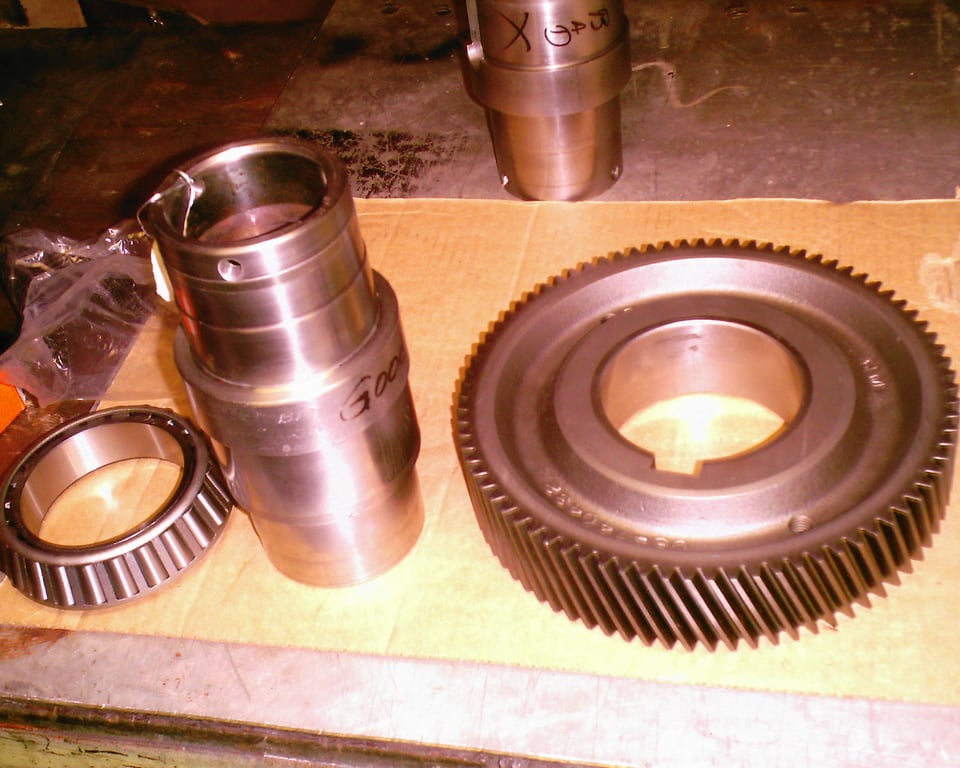
Macro view of machined helical gear teeth — A&K Machine & Fabrication, Jacksonville FL
Sprocket & Coupling Types

The Full Drive Train

Conveyor Chain Sprockets

Chain conveyor and drag conveyor sprockets in ANSI B29.1 Type II tooth form, pitches #25 through #240, plus custom tooth profiles for drop-forged, scraper, and elevator chains. Carbon steel, hardened alloy, cast iron, or UHMW for food-grade lines. Type A (plain), Type B (single-flange), Type C (double-flange) hubs.

Gear & Grid Couplings

Gear couplings (crowned-tooth) for high-misalignment, high-torque drives — the standard for heavy-duty conveyor drive trains. Grid couplings (Falk Steelflex-style) cushion impact loads with a serpentine spring grid. Custom bores, keyways, and shaft fits.

V-Belt Sheaves

Classical V-belt sheaves (A, B, C, D, E section per ARPM IP-20) and narrow-wedge (3V, 5V, 8V section, per ARPM IP-22). Single- to multi-groove, cast iron or steel, with QD, Taper-Lock, XT, or Split Taper bushing bores.

Jaw & Disc Couplings

Jaw couplings (Lovejoy-style) with elastomer spider for general-purpose drives — fail-safe under shock load, easy disassembly. Disc couplings use flexing steel discs for the highest precision and torque density. Specified by torque rating and shaft offset.

Synchronous-Belt Pulleys

HTD, GT3 (the current Gates standard, replaces GT2/GT), L, H, and XH profile timing-belt pulleys. Note: HTD and GT3 are NOT interchangeable despite similar tooth depths — they have different tooth forms. Cut to drawing for accurate tooth engagement; no slip, no creep.

Rigid-Flange Couplings

Bolted flange couplings for high-torque applications where alignment is rigid and predictable. No flex element — direct torque transmission. Machined to drawing, dynamically balanced for higher-RPM service.

Hardened & Hardfaced

Induction-hardened tooth profiles (HRC 50–55 on the working surface) for high-cycle service. Through-hardened sprockets for high-impact applications. Hardfaced overlay welding (chrome carbide) for drag-chain sprockets in highly abrasive material — the modern replacement for "ceramic faced" sprockets that don't really exist as a category.

17-Tooth Minimum (Chordal Action)

Standard design rule: keep sprockets at 17 teeth or more to minimize chordal-action vibration. Below 17 teeth, the chain's effective velocity oscillates noticeably and accelerates wear and noise. We flag this on quotes when a low-tooth-count replacement is requested.

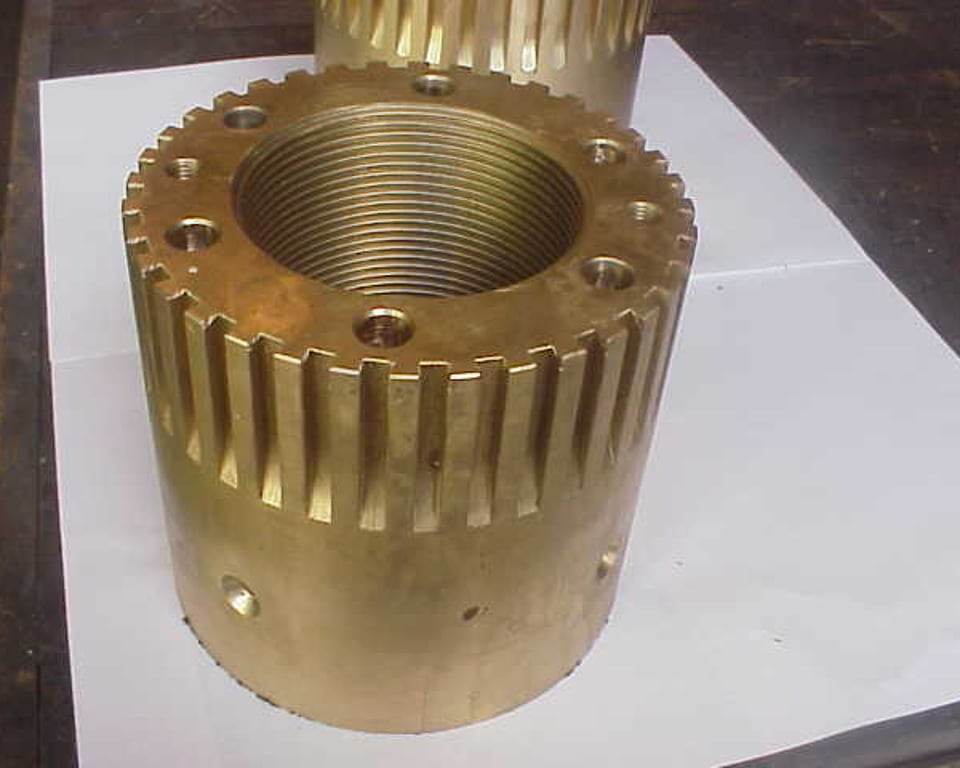
Large bronze gear sitting on shop floor — A&K Machine & Fabrication, Jacksonville FL
Materials & Heat Treatment

Pick the Spec for the Cycle

Sprocket teeth see the highest-cycle wear of any drive-train component. The right material + heat-treat combination is the difference between annual replacement and multi-year service.

1045 carbon steel
Standard service, moderate loads, occasional cycling. Tooth-induction-hardened to HRC 50–55 for added wear life.
4140 alloy (Q&T)
Heavier loads, higher impact. Through-hardened to HRC 28–32 base, tooth-induction-hardened to 50–55 surface.
8620 carburized
Case-hardened tooth surface to HRC 58–62 with a tough core. Right for high-cycle, high-impact drag and elevator chains.
Cast iron (ASTM A48 Class 30/40)
High-cycle, vibration-dampening, larger profile sprockets. Cost-effective for big diameters; can be flame-hardened at the tooth profile.
Hardfaced chrome carbide
Sprockets for drag and scraper conveyors in abrasive material — chrome-carbide overlay weld on a steel base. The modern equivalent of "ceramic faced" sprockets (which aren't a real off-the-shelf product).
UHMW
Food-grade and washdown service for modular-belt drives. Non-marking, FDA white grades available. Wears faster than steel but won't damage adjacent components.
Stainless 304/316
Corrosion service, food, pharmaceutical, chemical. 17-4 PH for higher-strength stainless applications.
Our Process

From Chain Pitch to Finished Sprocket

01

Spec

Send the chain pitch, tooth count, bore, and keyway — or just send the worn sprocket. We'll figure out the rest.

02

Quote

Material recommendation, heat-treat strategy, hub configuration. Fixed quote and real lead time.

03

Machine

CNC-cut tooth profile, bore + keyway broached or milled, hub diameter turned. Heat treatment per spec.

04

Ship or Install

Palletized for pickup, drop-shipped to your dock, or installed on-site during your scheduled outage.

Industries

Who We Supply Sprockets To

Common Questions

Sprocket FAQ

Can you match a sprocket I have without the OEM number?

Yes. Send the worn sprocket and we measure chain pitch, tooth count, bore, keyway, and hub style on the granite plate. Most ANSI standard sprockets come right off the catalog spec; custom profiles take a measurement pass and a tooth-form rebuild.

Should I order a sprocket "weld-on" or "hubbed"?

Hubbed is the default — separate hub, replace just the rim when the teeth wear, keep the hub forever. Weld-on is for higher-torque applications where you want a one-piece assembly without bolt-circle bolts. Pick hubbed unless you specifically need the strength.

Why do drag-conveyor sprockets wear faster than belt-conveyor sprockets?

Drag chains run through abrasive material — the material itself is moving past the sprocket teeth — while belt-drive sprockets see only the chain in clean air. The fix isn't "ceramic-faced sprockets" (not actually a real off-the-shelf product category); it's case-carburized 8620 (HRC 58–62 surface) or chrome carbide hardfaced weld overlay on the tooth profile. Either approach delivers 3–5× the life of a plain 1045 sprocket in abrasive drag service. We put these on our Scheduled Replacement Program for customers in mining, agriculture, and biomass-handling.

QD, Taper-Lock, XT, Split Taper — same thing?

All four are split-tapered bushings that wedge a hub onto a shaft when bolts are tightened. Taper-Lock (Dodge) is the most common — single-piece tapered sleeve, h7 shaft fit. QD ("Quick Disconnect") has a flange and through-bolt cap screws for easier removal. XT (Dodge) is a heavier-capacity through-bolt design. Split Taper (Browning) is dimensionally similar to Taper-Lock but uses different keyway/bolt patterns. We bore sprockets and sheaves for all four, and we'll spec the right one based on the torque you need to transmit.

HTD or GT3 — and which couplings for what?

For synchronous (timing) belt drives, GT3 is the current Gates standard — it replaces GT2 and GT, but is NOT interchangeable with HTD despite similar tooth depths. GT3 carries higher torque and runs quieter; HTD is the older curvilinear standard, still widely used. For couplings: jaw couplings (Lovejoy-style) for general purpose and shock loads, grid couplings (Falk Steelflex) for cushioned heavy-duty, gear couplings for high-misalignment high-torque, disc couplings for precision/high-RPM, rigid flange for direct-coupled drives where alignment is held within microns. We machine all five.

Can you make a sprocket out of UHMW?

Yes — common for food-grade and modular-belt drive applications. UHMW sprockets are non-marking, FDA-compliant (in the right grade), and won't damage the chain or modular belt. They wear faster than steel but won't damage adjacent components.

What's the lead time on a custom sprocket?

Standard ANSI sprockets in carbon steel: usually 5-7 business days. Hardened alloy or stainless: add a few days for outside heat treat. Fully custom tooth profiles: 1-2 weeks for first-piece. Call 904-388-7772 with your spec and we'll give you a real answer before you commit.

Other Conveyor Components

The Rest of the Drive Train

Get a Quote

Start Your Project

Send us your details — drawings, dimensions, or just a description. We'll get back to you within 48 hours on most quotes. For faster response or lead time questions on jobs, just call.

PDFs, images, Office docs, CAD files, or ZIPs — max 20MB.
Need to send more? You can upload additional files after submitting.

or call 904-388-7772

Fast Response

We respond to most quote requests within 48 hours. For faster responses or lead time questions on specific jobs, call us directly at 904-388-7772.

We Ship Anywhere

Based in Jacksonville, FL — we ship finished parts and components throughout Florida, the Southeast, and beyond.

Prefer to Call?

Reach us at 904-388-7772, Mon–Fri 7:00 AM – 3:30 PM (closed Sat–Sun).