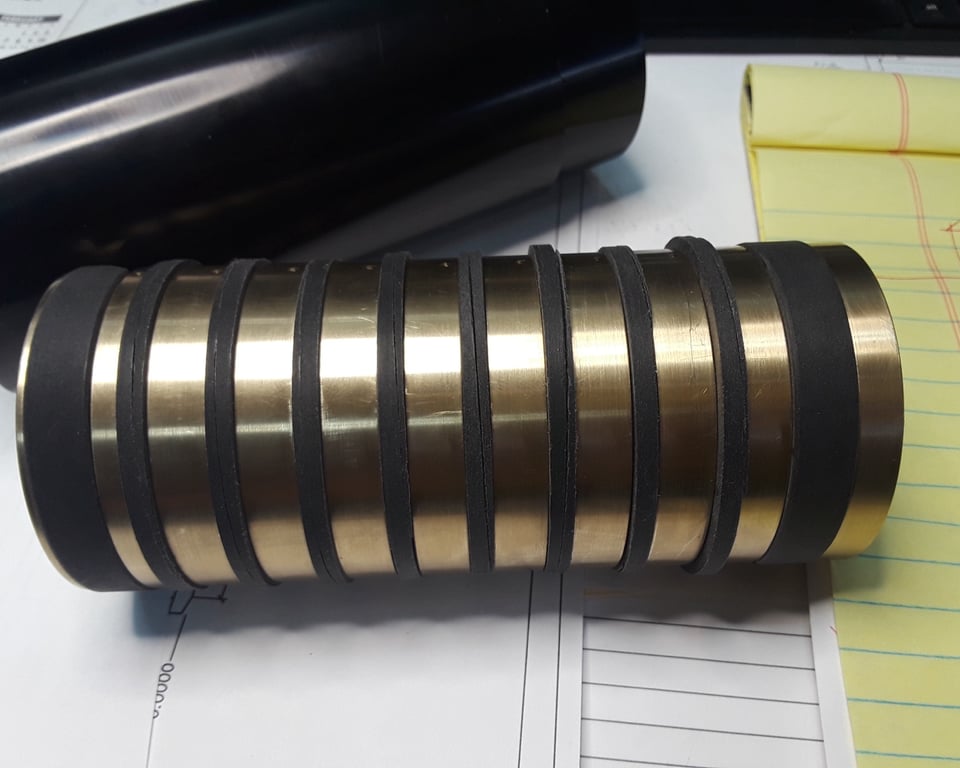
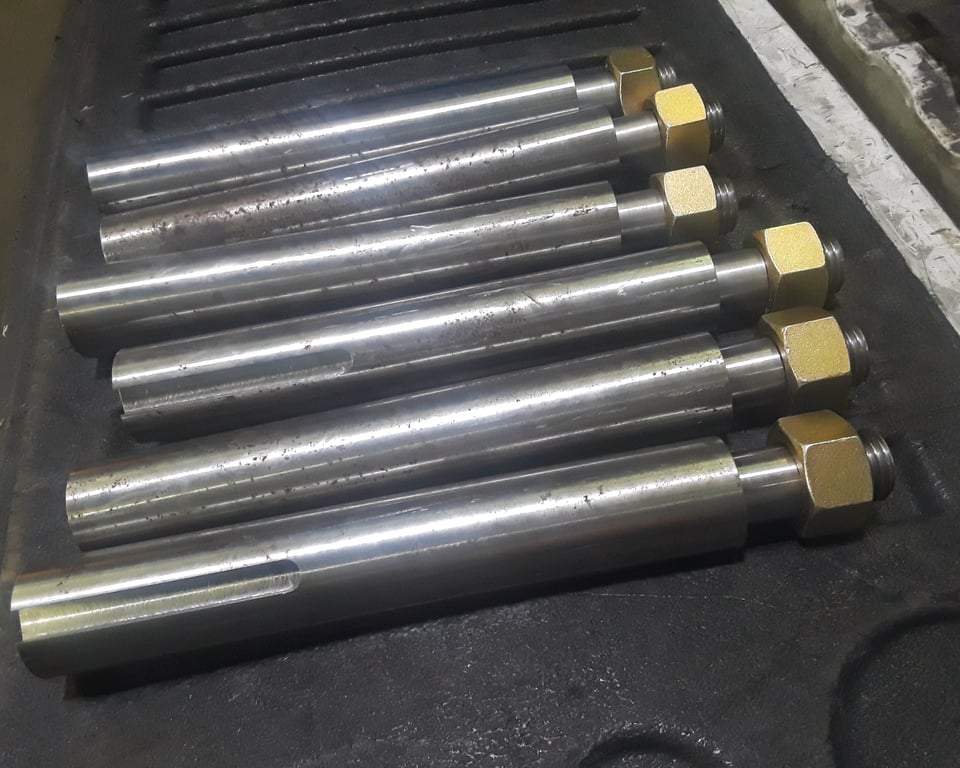
Custom carrying, return, impact, and training idlers — machined to match your conveyor's belt width, load rating, and frame spacing. Any troughing angle, any roll diameter, any bearing spec. Reverse-engineered from a worn sample if drawings aren't available.
Idlers do the unglamorous, high-mileage work of every belt conveyor: supporting the belt, supporting the load, keeping the system tracking straight, and absorbing impact at load points. When they wear or fail, the belt drifts, the edges fray, the carry-back accelerates — and you're shutting the line down sooner than you planned.
A&K machines complete idler assemblies and replacement rollers to your conveyor's exact spec. We work from your sample, your OEM number, your gearbox or frame dimensions, or your CAD drawings. Standard and non-standard configurations both run through the same shop.

From the head pulley to the tail pulley, every section of a conveyor needs the right idler for its role. A&K machines all of them.
Support the loaded belt on the carrying run. Flat single-roll, two-roll V, three-roll troughed (20°/35°/45° per CEMA 502), and five-roll picking sets for wide belts. Roll diameters 4"–7"; sealed cartridge or greaseable taper-roller bearings.
Support the empty belt on the return run. Flat single-roll, two-roll V-return (10°), and self-cleaning rubber-disc / spiral return configurations — pick rubber-disc or spiral when carry-back is hammering your return strand and grinding into the roll face.
Self-aligning trainers for carrying and return strands. Pivot-frame designs with steering rollers sense belt drift and angle the trough to correct it before edge damage or spillage. Essential on long-center conveyors where small misalignments compound over hundreds of feet.
Rubber-cushioned rolls positioned under load points to absorb the energy of material drop. Standard rubber-disc impact rolls or solid impact bars handle the bulk of installs; protects the belt from punctures and reduces vibration through the structure. Spaced 6"–12" centerline under high-impact transfer chutes.
Gradient-angle idlers (typically half the trough angle, then full) for the zones near head and tail pulleys where a troughed belt has to flatten out. CEMA recommends a minimum transition distance of ~2× belt width on standard troughs to keep edge tension within limits.
CEMA Class E / F rolls for high-tonnage aggregate, finned rolls for wet/sticky material, ceramic-faced rolls for highly abrasive applications, and stainless rolls for washdown and chemical service. Built-to-print solutions when standard catalog parts won't survive your environment.

Idler service life is mostly about matching the material and bearing to the environment. The wrong combination wears out in weeks; the right one runs for years. CEMA standard 502 sets out six load classes — A through F — and we spec the bearing, shaft, and seal to land you with the L10 life you actually need.
Most "belt tracking problems" actually start at the idler spacing — too far apart and the belt sags between sets, scrubs the edges, and drifts. Too tight and you're paying for steel that isn't earning its keep. CEMA gives clean rules of thumb:
Belt drifting? Walk it like this before you call in a tracking-roll swap:
If you've cleared all of those and the belt still drifts, that's when training idlers earn their keep. We supply pivot-frame trainers (Hyde-style, Flexco-pattern, or built to your OEM print) for both carrying and return.
If you can give us the spec below, we can usually quote within a business day and machine a drop-in replacement within a week. If you're missing pieces, we work from a worn sample on a granite plate — we just need it shipped or dropped off.

Send us a worn idler, the OEM tag, or the frame dimensions. We measure on a granite plate, identify wear modes, and come back with a fixed quote and a real lead time.
We recommend the material and bearing combination based on your environment — not just "what the OEM used." If wear has been heavier than expected, we upgrade the spec for the next cycle.
CNC-turned shells, machined end caps, pressed-in bearings, balanced rolls. Every assembly is inspected against the print before it leaves the machine.
Palletized for pickup or drop-shipped to your site. For customers in our service area, our on-site crew can swap them in during your scheduled outage.
Yes — this is one of the most common reasons customers call us. Send the worn idler (or just a photo + the frame spacing), and we'll reverse-engineer a drop-in replacement. The bearing bore, shaft diameter, length, and frame-bolt pattern all come out matching the original.
Per CEMA 502, 20°, 35°, and 45° are the standard three-roll troughing angles. We also build flat (0°), two-roll V-trough, and five-roll picking idler sets for wider belts and deep-trough service. The angle drives load-carrying capacity for a given belt width — a 45° trough on a 36" belt carries roughly 1.5× the volume of a 20° trough at the same speed. Send us belt width, bulk density, and tph and we'll recommend the right angle.
CEMA 502 divides idlers into Classes A through F by belt width, roll diameter, and shaft size. Rough rule: light packaging service is Class B, general industrial is C, mining/aggregate is D or E, and severe-duty (taconite, ore, primary crusher discharge) is F. The class governs bearing size, shaft diameter, and L10 life target (typically 60,000 hours for B–C, 30,000 for D–E severe). If you tell us belt width, material, and tph, we map it to the right class — and if your existing idlers are wearing fast, we'll bump you up a class on the replacement.
Sealed cartridge bearings are factory-packed and never re-lubed. They're the right call when access for routine greasing is impractical (overhead conveyors, return strands buried in the structure) and the environment is moderate. Greaseable taper-roller bearings carry higher loads, run cooler under heavy service, and let you flush contamination out — required for Class E/F duty and recommended where dust or water is constant. Triple-labyrinth or taconite seals add another layer of contamination defense on either type.
Probably not, at least not directly. Tracking problems usually trace to a structural issue (out-of-square frame, cocked idler), an off-center load (chute misalignment), a worn pulley crown, a non-square belt splice, or just under-tension. Walk those first — see our troubleshooting checklist above. If you've cleared all of those and the belt still drifts, training idlers are the right next move. We supply pivot-frame trainers on both carrying and return strands.
Three signs: roll surface grooved or out-of-round (run your hand along it — a smooth roll is healthy); audible bearing noise when the line is running; or hot housings to the touch. Any one of those means the idler is past service life and the belt is paying for it in extra wear.
Most standard idlers ship within a few business days when material's in stock. We prioritize emergency breakdown work — call 904-388-7772 with your specs and we'll tell you straight whether we can hit your deadline before you commit.
Both. For customers in our service area, our on-site crew can swap idlers during your scheduled maintenance window — measured, installed, belt re-tracked, and tested before we leave.
Head, tail, snub, and bend pulleys with crowned faces and your choice of lagging — bare steel, rubber, ceramic, or polyurethane.
2-bolt and 4-bolt pillow blocks, take-up units, and flange-mount housings for the bearing on every idler, pulley, and shaft.
Back to the full conveyor parts overview — gearbox shafts, scrapers, sprockets, take-ups, auger flighting, and more.
Send us your details — drawings, dimensions, or just a description. We'll get back to you within 48 hours on most quotes. For faster response or lead time questions on jobs, just call.
We respond to most quote requests within 48 hours. For faster responses or lead time questions on specific jobs, call us directly at 904-388-7772.
Based in Jacksonville, FL — we ship finished parts and components throughout Florida, the Southeast, and beyond.
Reach us at 904-388-7772, Mon–Fri 7:00 AM – 3:30 PM (closed Sat–Sun).